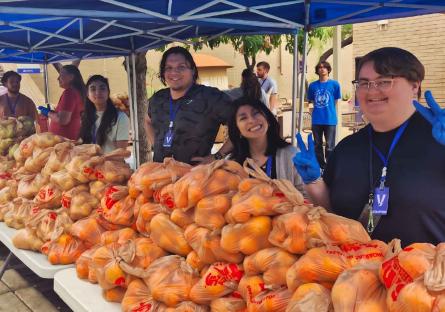
For many students, having access to nutritious food can make a meaningful difference in their ability to focus, learn, and thrive. Paradise Valley Community College (PVCC) is helping meet that need through its monthly food distribution, providing free food to students, employees and community members while highlighting the important connection between food access and overall health.
In partnership with St. Mary’s Food Bank, PVCC distributes food at Cordova Plaza, in the heart of the Union Hills campus outside the KSC building. The monthly distribution, organized by PVCC’s Student Life and Leadership office, serves more than 200 families and reaches up to 700 students and community members, providing an important resource for those facing food insecurity.
The effort is more than a food distribution; it also reflects PVCC’s broader commitment to health and wellness and the work of its Nutrition and Dietetic Technology program, which prepares students to promote healthier communities through nutrition education, sustainable food practices and improved access to healthy food.
Connecting Food Access to Better Health
Good nutrition plays an important role in preventing chronic disease, maintaining a healthy weight, and supporting overall well-being. PVCC’s Nutrition and Dietetic Technology program prepares students to become advocates for healthier communities, with an emphasis on sustainable food practices, nutrition education, and improving access to healthy food.
At the forefront of the program are Director Angela Jordan, MEd, BS, DTR, CPT, and Lab Coordinator Nanci Orozco. Both, proud graduates of PVCC’s Nutrition and Dietetic Technology program, now lead and mentor the next generation of nutrition professionals.
“We want our students to understand that nutrition is about so much more than what we eat,” Jordan said. “Food access, education, and health are all connected. When our students can see those connections in their own community, it gives greater meaning to what they’re learning and prepares them to make a difference wherever their careers take them.”
PVCC’s Nutrition and Dietetic Technology Associate in Applied Science degree offers students a hands-on entry point into the field. Unlike the Registered Dietitian Nutritionist pathway, which requires 1,000 hours of supervised internship experience, PVCC’s Nutrition and Dietetic Technician, Registered (NDTR) program integrates 466 hours of supervised practice with classroom instruction.
Students gain experience in three essential areas of dietetics:
- Medical Nutrition Therapy
- Community Nutrition
- Food Service Management
Through classroom instruction and hands-on experience, students develop skills in patient assessment, nutrition counseling and education, medical record documentation, disease prevention, sustainable food practices and more.
From PVCC to the Workplace
The program’s combination of classroom learning and supervised practice is helping students move quickly from education into careers.
Three recent PVCC Nutrition and Dietetic Technology graduates have earned positions at Mayo Clinic in Scottsdale, while another current student completed her medical nutrition therapy rotation at Phoenix Children’s Hospital and recently gained employment there.
“We’re seeing our students take what they learn here and turn it into immediate career opportunities,” Jordan said. “That’s incredibly rewarding. They leave PVCC with hands-on experience, professional skills, and a strong foundation they can build on.”
After completing the program, graduates can take the national examination administered by the Commission on Dietetic Registration to earn the NDTR credential. Career opportunities include clinical nutrition, food service, community and public health, wellness, business and entrepreneurship, and sustainability and food security initiatives.
For more information about PVCC, food distributions, and programs and certifications, visit the website.