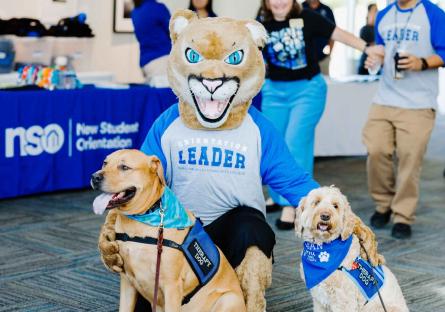
There’s a certain reaction that happens when therapy dogs Logan and Cooper arrive at Paradise Valley Community College. People smile. They stop to say hello. Some make a beeline for the dogs, while others simply brighten at the sight of the two familiar faces.
Now in their second year visiting PVCC, Logan, Cooper, and their handlers Linda Rose and Linda Pessin (affectionately dubbed ‘the Lindas’), are known around campus and have become part of the PVCC community.
“Logan and Cooper wear their Puma scarves proudly when meeting old and new friends alike,” said Rose, Logan’s handler.
More Than a Friendly Face
Therapy dogs are trained to provide comfort and companionship in settings where people may be experiencing stress, anxiety or difficult circumstances. Research has found that interacting with therapy animals can help reduce stress and improve mood.
For Rose, the benefits are easy to see. “I see the reaction people have when visiting with the pups and it’s pure joy,” she said. “The dogs provide comfort and give positive reinforcement to people no matter what they’re going through.”
That can be especially meaningful for college students, who may be balancing academics with work, family responsibilities, finances, and other challenges.
“College can be challenging,” said Emma Magana, Student Life and Leadership, PVCC. “Reducing stress, improving moods, and staying engaged are so important for students. The Lindas, Cooper, and Logan do just that. They create belonging and provide moments of comfort that keep students regulated, focused, and shining a little brighter.”
Linda Pessin, Cooper’s handler, said sometimes a few minutes of distraction and connection are all someone needs. “Dogs bring out the best in everybody and just a little distraction from what people are focusing on goes a long way,” she said.
Students often open up while petting the dogs, Pessin added. “You don’t know what their home life is like, you don’t know their financial situations or what’s weighing on them,” she said. “When they’re with the dogs, they relax enough to open up and share with you, which can ease their burdens at least for a moment.”
While talking doesn’t necessarily solve a problem, she said, having someone listen can make all the difference.
Meet Logan and Cooper
At five years old, Logan is a multigenerational Australian Labradoodle with a calm temperament that became apparent when he was still a puppy. Rose initially enrolled Logan in behavioral training simply to help with obedience, but his temperament quickly suggested he could do more. After completing the necessary training, Logan became an advanced therapy dog through the American Kennel Club.
Cooper, a Staffordshire Bull Terrier, American Pit Bull, and Labrador mix, is also five and weighs in at 114 pounds. Adopted from the Humane Society, his temperament was so calming, he too, was a great fit for therapy. Cooper earned his AKC certifications and began his career greeting travelers at Phoenix Sky Harbor International Airport.
Today, Pessin and Rose, both retired, spend their days of retirement visiting municipal courts, county offices, 911 call centers, and colleges with their pups. “They both love the positive reinforcement they receive from people,” Rose said.
Creating a Sense of Safety and Community
For Pessin, one of the most meaningful parts of the visits to campus is seeing students discover that dogs can be a source of comfort and safety.
Not everyone grows up around dogs, Pessin explained. Students can come from a variety of cultural and personal backgrounds and have very different experiences with animals. Meeting a friendly, highly trained therapy dog in a calm, controlled setting can provide an opportunity to develop a new relationship with dogs.
That connection fits naturally into what both Lindas say they see at PVCC.
“The PVCC campus is so diverse and so welcoming,” Pessin said. “It creates a genuine community feeling. It’s more than a community college; it’s a place where students feel safe, they’re happy, and it’s a joy interacting with them.”
Rose said she experienced that sense of community from her very first visit. “From the get-go we were embraced with open arms by everyone we met,” she said. “PVCC takes the word community to heart, and ‘community’ plays into everything they do.”
She has been impressed by the many resources PVCC offers students, from tutoring and counseling to community outreach. “It’s a small school, but students are really connected to one another,” she said.
And now, Logan and Cooper are part of that connection. Whether they are greeting a student between classes, providing a few minutes of stress relief or simply offering a friendly face on campus, the dogs have become familiar and welcome visitors.
The dogs’ upcoming visits include: November 9 and18, and December 8.